News and Articles

Industry Perspective
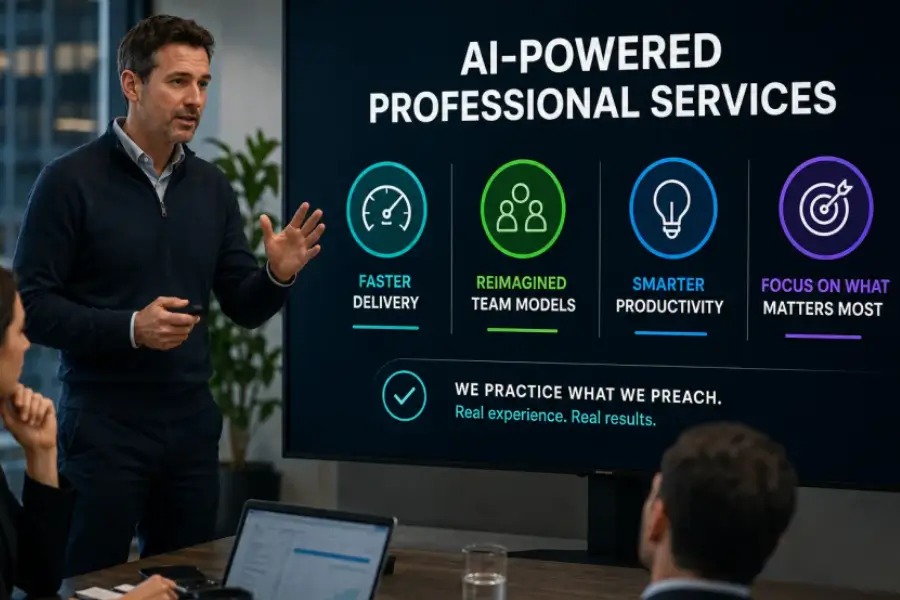
The Art of Living Inside Your Own Recommendations
Drawing from his firsthand experience as an executive running an AI overhaul within his own company, Certinia’s Vice President of Professional Services Shane Ward argues that PS leaders must stop hiding behind polished, theoretical slide decks and personally live through the grueling change management process so they can offer clients hard-earned, realistic wisdom rather than insulated cookie-cutter advice.

Industry Perspective
Service Beyond the Bottom Line
Service shows up in how Diabsolut's people spend their time when no one's asking them to. This International Services Week community spotlight reflects on what it looks like when a team of 120+ people consistently show up — for sick kids, for rare disease research, for friends, for animals, for communities facing food insecurity. No single initiative connects these stories. What does is a pattern of long-term, personal commitment that runs deeper than any mission statement. That's the kind of company culture that doesn't get manufactured. It gets revealed.

Industry Perspective
Professional services built its tech stack for timesheets - AI changed the rules
Certinia CFO Robert Cesafsky highlights that while AI is fundamentally changing the rules of professional services delivery, legacy tech stacks built entirely around manual timesheets are now obsolete. When firms rely on siloed, historical record-keeping, they lack the real-time visibility needed to optimize utilization rates and predict project profitability. Ultimately, thriving in the modern services era requires moving toward connected financial intelligence that pairs automated tracking with real-time operational data.
Industry Perspective
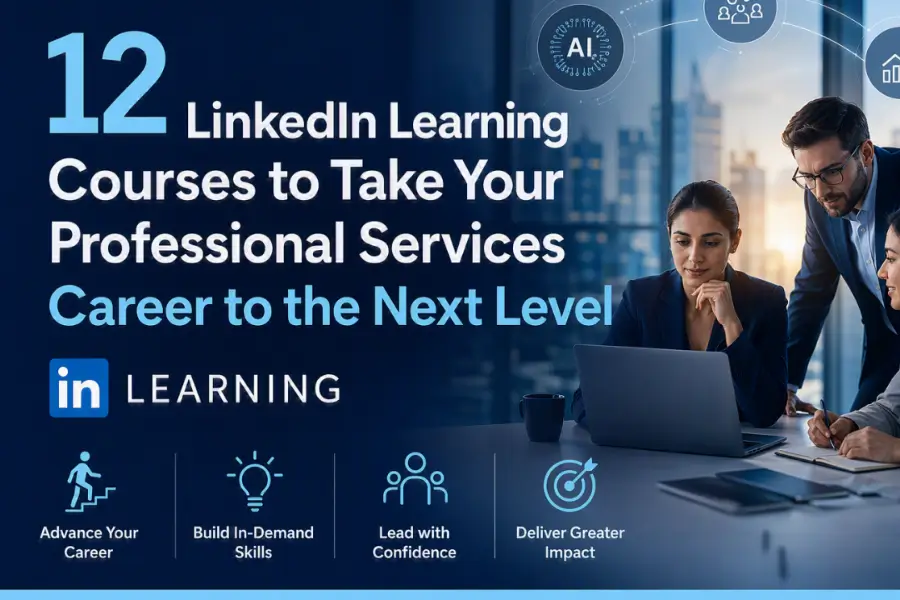
12 LinkedIn Learning Courses to Take Your Professional Services Career to the Next Level
Leveraging his extensive experience in global change and training initiatives, LinkedIn Learning’s Simon Howson-Baggott curates 12 critical courses—ranging from financial fluency to executive leadership—designed to help professional services practitioners close the skills gap and pair AI-driven automation with irreplaceable human judgment.

Industry Perspective
AI Makes Your Business Faster. Is Your Business Wiser For It?
Writing for Inc.com, Certinia CEO DJ Paoni cautions that while AI can make a business faster, adopting it without a connected organizational structure will only accelerate operational chaos. When firms deploy AI across separate, siloed systems, the technology lacks the context it needs and scales existing blind spots that can quietly damage net revenue retention. Ultimately, successful adoption requires a unified data foundation that pairs AI's pattern recognition with experienced human judgment.

Industry Perspective
Accelerating with AI Requires Orchestrating Trust
Because B2B buyers increasingly use AI to vet vendors early, independent market trust has become more critical than ever. As Tyler Johnson notes in an article for Spotlight, while automation accelerates discovery, it cannot replicate the deep credibility built through analyst validation and peer proof. To win, professional services firms must orchestrate these external signals to validate their authority long before the first sales call.

Industry Perspective
The handoff quietly killing your NRR (that doesn't happen in customer success)
In Customer Success Collective, Steve Frost (Head of Executive Advisory – Customer Success at Certinia) warns that the traditional handoff between professional services and customer success is quietly damaging net revenue retention. When implementation teams prioritize technical go-live milestones over long-term value, critical customer insights are often lost. To prevent early churn, companies must structurally align both departments around continuous customer outcomes.

Industry Perspective
Building the Foundations for Intelligent Service Operations
Many professional services firms are rushing to adopt AI, but technology alone won't guarantee success without operational readiness. In fact, introducing AI into an environment of disconnected systems and poor data will only amplify existing problems rather than solve them. This article from Xenogenix outlines the essential operational blueprint needed to build a mature, connected foundation where intelligent automation can actually thrive.
Industry Perspective
How AI is Accelerating the Shift to Value-Based Pricing
In an article for Ladd Partners, author Nathan Threlkeld argues that the traditional billable hour is becoming a ceiling on growth as AI reduces the time required to complete tasks. Because charging by the hour penalizes efficiency in an automated landscape, professional services firms must decouple their revenue from linear time. Transitioning to a value-based pricing model allows firms to stop selling logged hours and instead capitalize on the actual economic impact they deliver to clients.
Industry Perspective
theCUBE: AI Is Making Human Judgment More Valuable, Not Less. Here's Why
Certinia's Prasad Sulur joined PwC's Matt Cook and theCUBE Research's Scott Hebner to argue that professional services firms chasing AI-driven efficiency are missing the bigger prize. Watch the full conversation to find out what separates the firms already generating real business outcomes from those still stuck in pilot mode.
Industry Report
Seven Steps to Avoid a Failed PSA Implementation
MGI Research outlines seven steps for avoiding failed PSA implementations, centering on clear use‑case definition, strong fit by vertical and scale, and realistic year‑one cost expectations across tiers. It urges buyers to vet software providers and systems integrators rigorously, emphasizing data model flexibility, innovation trajectory, and disciplined handling of implementation, integration, and change‑management drivers of total cost. The note also calls for a skeptical, evidence‑based view of AI marketing, favoring workflow‑native capabilities with explainability and sustained investment, and points to recurring success and failure patterns as practical guardrails for PSA programs.

Industry Perspective
Leveling Up Starts Within: Emotional Intelligence as a Growth Strategy
Development plans tend to chase certifications and the next technical skill, but the one with the highest long-term return rarely makes the list: emotional intelligence. And it isn't the unflappable calm we tend to picture, says Robyn Duffy of Diabsolut. It's the ability to notice what you're feeling, understand what's underneath it, and choose your response instead of getting hijacked by it. That's a learnable skill, not a fixed trait, which is exactly what makes it a growth strategy worth practicing on purpose, imperfectly, over time.

Industry Perspective
Fixing the Customer Journey: Why Value Has to Travel Beyond the Sale
Most firms struggle to prove customer impact because the original business case fades as the relationship moves from Sales to Services to Customer Success. Apricity Group argues for a connected value journey where substantiated business goals and living value assessments travel across CRM, PSA, and ERP so every team operates from the same definition of customer value. They outline a six-motion model that carries the value story from evaluation through delivery, adoption, executive communication, and expansion, giving customers clear evidence to measure and defend the impact of their investment.
Industry Perspective
NextGen ProServ: Upgrade FM + Unaric Payments with OpMentors
NextGen ProServ host Molly Adams sits down with Jim Smith, COO of Unaric Payments, to discuss the modernization of the Office of the CFO. Drawing on his consulting background and youth soccer coaching experience, Jim discusses empowering finance teams to accelerate collections, reduce manual effort, and improve financial visibility. This conversation provides CFOs and finance leaders with practical insights on balancing growth, risk, and customer experience in an increasingly digital world.
Industry Perspective
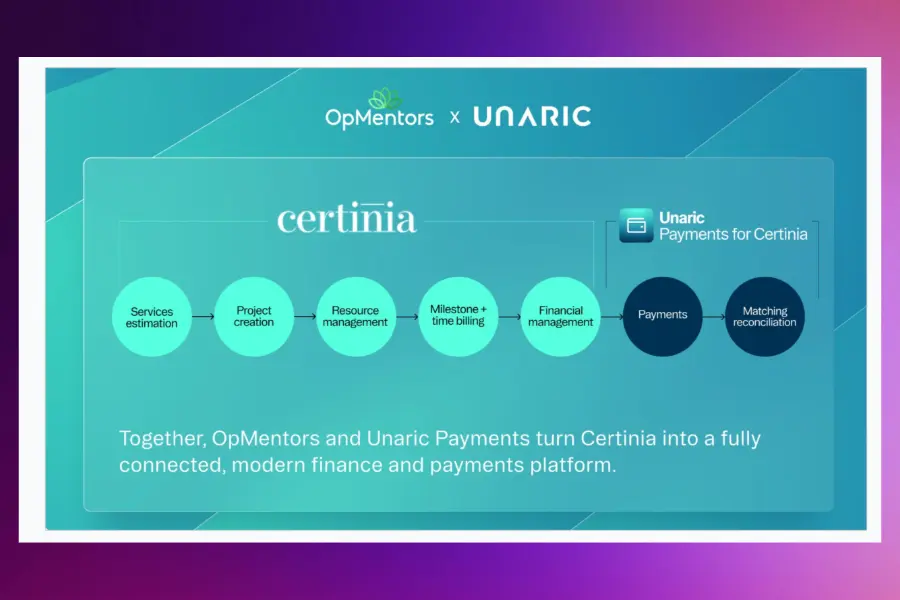
Your ERP Is Not Your Last Mile. Why Payments Is the Next Strategic Frontier for Certinia Leaders
Despite modernizing their front and middle offices, many professional services leaders still handle the critical "last mile" of cash collection through fragmented, external payment systems. As OpMentors writes, integrating payment orchestration natively within Certinia eliminates this operational friction, reducing manual reconciliation while accelerating cash conversion. Ultimately, keeping payment data inside the core ERP provides a unified data model that enhances executive forecasting, unlocks AI readiness, and completes the enterprise's digital transformation.
Industry Report
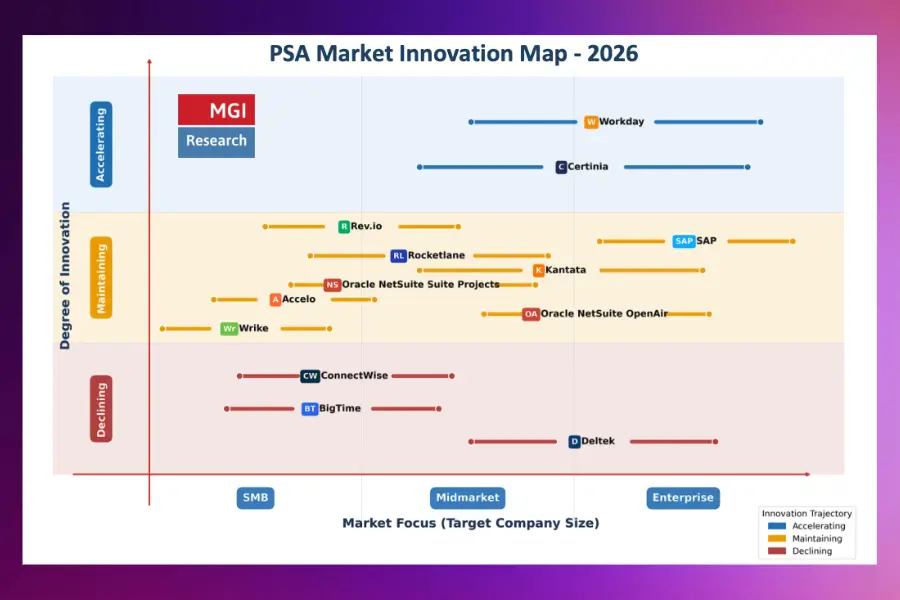
Assessing PSA Vendor Innovation: Leaders and Laggards
According to MGI Research, the Professional Services Automation (PSA) market has reached a critical inflection point as supplier innovation sharply diverges into accelerating leaders, a maintaining middle tier, and legacy laggards. While frontrunners set new benchmarks by deeply embedding agentic AI into their core architectures, other vendors remain constrained by tactical features or profit-driven consolidation. With this competitive divide projected to widen significantly over the next three years, this report serves as an essential roadmap for firms looking to adopt transformative tooling and navigate an evolving industry landscape.

Industry Perspective
International Services Week 2026: Accelerating with AI, Leading with Judgment
As AI moves from the sidelines into the core of client work, International Services Week 2026 asks a pointed question: what remains distinctly human in professional services? This Consulting Magazine feature kicks off a two-wave article series on how firms can pair AI-driven acceleration with trust, judgment, and solid operational foundations. With insights from Diabsolut, 10Fold, and Coalescence Cloud, the article highlights trust-building as a learned skill, AI as a force multiplier that heightens the need for human review, and the idea that readiness and governance must come before tools.
Industry Perspective
Analyzing the 2026 SPI Research Professional Services Maturity Benchmark Report
Certinia unpacks five big trends from the 2026 SPI Professional Services Maturity Benchmark Report and what they mean for how services firms run and grow. Growth has returned but remains below historical norms, utilization has hit a survey low, AI is now present in over a quarter of projects, attrition has eased but skills readiness is the new constraint, and profitability is stable even as a gap widens between high-maturity firms and everyone else. The core message is that future performance depends on how well leaders connect decisions across pipeline, staffing, skills, delivery, and financials, supported by an AI-ready, integrated operating model.

Industry Perspective
Your Firm Has Two AI Problems. Most Leaders Are Only Solving One
Many firms deliver underwhelming results with AI because they mistakenly deploy a single, generic AI layer across two fundamentally different operational domains: services delivery and services management. In The AI Journal, Certinia’s Raju Malhotra explains that while delivery thrives on probabilistic, human-in-the-loop LLMs to accelerate client work, management demands deeply integrated, deterministic AI agents to run strict backend operations without costly errors. He outlines how building a proper architecture that separates these domains eliminates administrative burdens, reallocates critical resources, and seamlessly aligns the entire engagement lifecycle from sale to revenue recognition.

Industry Perspective
Service Is Still a Human Business
The article by Diabsolut SVP John Pettifor argues that AI is making service work more human, not less. As the technology gets more capable, people are leaning harder on trust, dialogue, and collaboration rather than abandoning them, and the organizations that win design for that reality instead of pure automation. John frames this as strengthening services through dialogue: conversation becomes the interface for getting work done, trust and clear governance determine whether people actually adopt the tools, and faster routine work frees teams up for better judgment and collaboration rather than replacing it.

Industry Perspective
Turning AI pilots into measurable ROI and professional services growth
Many services firms are stuck in an AI “pilot stall,” where investments look exciting but fail to materially move revenue, margin, or risk KPIs. In diginomica, Certinia’s Sridar Parameshwaran (Vice President of Value Advisory) shares how AI‑first professional services organizations use unified data and embedded AI agents to run 3–4x more projects, compress 8‑month timelines into 8 weeks, and cut revenue leakage, margin erosion, and cash‑flow risk. He outlines three KPI areas leaders should track to turn AI experiments into measurable ROI: revenue growth, margin optimization, and business risk mitigation.
Industry Perspective
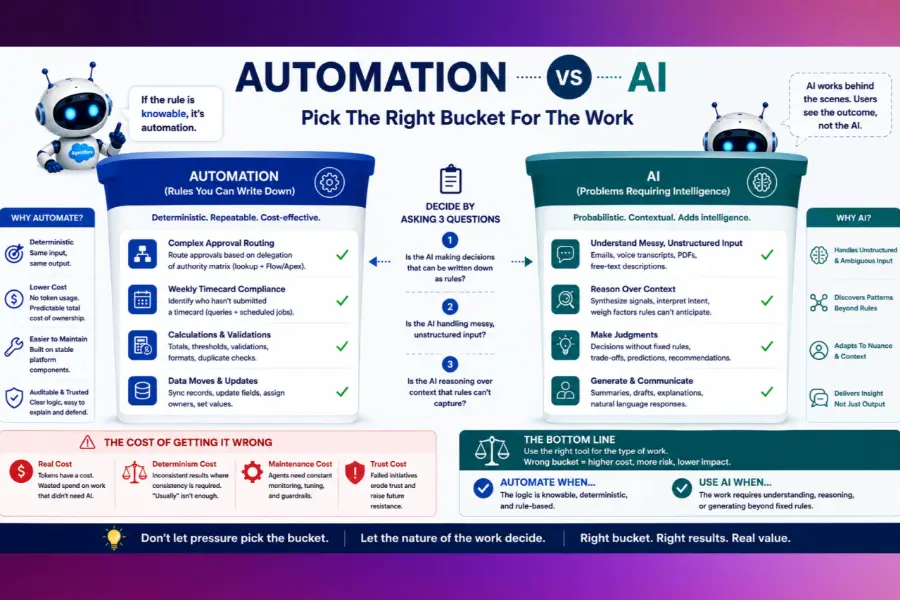
Automation vs AI: Pick The Right Bucket
Driven by executive pressure and organizational FOMO, many companies are mistakenly pushing traditional automation tasks into expensive and overly complex AI buckets. Cecilia Chiderski, Director of AI at CLD Partners explains how forcing "knowable," rule-based problems into AI models inflates token costs, compromises data determinism, and destroys user trust. She introduces a practical three-question framework to help project teams clearly distinguish genuine AI use cases from standard automation tasks before misallocating their budgets.

Industry Perspective
Why Are So Many Services Firms Solving the Wrong AI Problem?
Failing to distinguish between client-facing delivery and back-office management is one major reason why professional services organizations often see marginal AI returns. Citing his recent byline in Harvard Business Review and interview with R “Ray” Wang from Constellation Research, Certinia COO Robert Cesafsky explains that while delivery thrives on probabilistic, creative tools, management requires deterministic, auditable agents to ensure financial rigor. By architecting a clear divide between these two domains, firms can finally move past stalled pilots to capture the economic gains that currently elude most of the industry.
Industry Perspective
What the 2026 SPI Benchmark Is Telling Us
The 2026 SPI Research benchmark shows professional services firms posting their strongest numbers in years on margin and revenue per consultant, yet billable utilization fell to 66.4%, the lowest in the benchmark's 19-year history. Diabsolut’s Uriah Hakala argues this isn't a delivery problem firms can solve by buying AI, it's a visibility problem: leaders can't see demand clearly enough to staff against it. The fix is connecting the systems you already have to rebuild your delivery around outcomes.

Industry Perspective
Accelerating with AI. Leading with Judgment. The Tension Every Professional Services Leader Needs to Resolve
PS firms that shift from bolting on isolated tools to redesigning workflows around automation find the structural discipline and trust to turn rapid execution into clear financial impact. In this article, CXO Spice author Helen Yu looks at the widening judgment gap as top organizations fix untrustworthy data, build formal roadmaps, and give leaders a clear, measured view of actual returns. With those baselines established, technology starts driving returns, from handling high-stakes situations to reading ambiguous client needs and making calls backed by real experience.

Industry Perspective
Accelerate with AI. Lead with Judgment: Why Mastering Both Is the Defining Challenge for Services Organizations Today.
AI can compress weeks of work into days, but the real challenge for services organizations is deciding where speed actually creates better outcomes. VFP Consulting’s Ty Alibhai argues that leaders now have to design “intelligent guardrails” around AI—governance, experimentation, and judgment calls—so automation reinforces, rather than erodes, expertise. He frames the next era of services as a leadership test: who can blend AI’s acceleration with human discernment to rethink how projects are scoped, staffed, and steered from the ground up.

Industry Perspective
From the Front Line – Leading business transformation in Customer Success
Customer Success teams that move from scattered spreadsheets to a dedicated platform gain the data, structure, and visibility to turn “good” relationships into scalable, measurable growth. In this article, dForce’s Di Prime follows two subscription businesses as they standardize customer journeys, align CSMs around shared success plans, and give leaders a single, trusted view of health, risk, and progress. With that foundation in place, AI stops being theory and starts doing the work, from automating QBR prep to predicting churn, surfacing expansion, and sharpening leaders’ calls across the customer lifecycle.

Industry Perspective
From AI Mandate to Measurable Value: Preparing Professional Services Teams for Their First AI Solutions
AI mandates are easy to hand down. Readiness is harder to build. Coalescence Cloud's Lindy Thompson makes the case for why professional services teams need to start with the operating problem rather than the tool, and lays out a practical framework for moving from AI ambition to measurable value. She also tackles the two traps most organizations fall into: endless experimentation that never becomes operational, and premature deployment into an environment that can't yet support trusted, measurable use.

Industry Perspective
The Biggest Barrier to AI in Professional Services Isn’t Technology
Xenogenix argues that the biggest barrier to AI adoption in professional services isn't the technology itself. It's operational maturity. Organisations that struggle with inconsistent reporting, siloed data, and undocumented processes will find AI amplifies those gaps rather than closing them. The piece offers a practical framing for services leaders to assess whether their operational foundations are actually ready to support AI before they scale it.

Industry Perspective
Faster isn't the same as smarter with AI
Diabsolut’s Rachel Chand (Senior Director, Solution Engineering) examines the gap between AI's speed and human judgment, and why mistaking one for the other is where most AI adoption goes wrong. Drawing on research that links heavy AI use to weaker critical thinking and lower brain engagement, it argues that more output without the friction that produces good thinking just creates polished, plausible, subtly wrong work (the kind experienced readers spot immediately). It separates using AI to free skilled people for harder problems from using it to avoid developing skilled people at all.

Industry Perspective
The pricing problem hiding inside every AI services win
AI is transforming delivery economics across PE-backed services businesses, but most client contracts are still stuck in a time-and-materials model that hands efficiency gains to the client rather than the firm. Adam Rosenfield, Director at Accordion, believes the core problem is a structural mismatch: providers invest in AI tooling, absorb implementation costs, and train their teams, only to watch the savings show up on client invoices instead of the income statement. The firms closing that gap are moving fast on three fronts: repricing new logos on outcome-based structures, rebuilding back-office infrastructure around current delivery economics, and sequencing both against the hold period so the margin story is already written by the time buyers come knocking.

Industry Perspective
Your AI Is Working. That Might Be the Problem.
Many enterprises are currently caught in a trap where their "good enough" AI tools provide fluency without delivering true operational value or solving complex business problems. As Certinia CPTO Raju Malhotra writes in AIThority, this generalist approach fails for professional services firms because it lacks the necessary context regarding resource availability, financial constraints, and contractual obligations. Moving forward, organizations must shift toward purpose-built, agentic AI systems that are grounded in real-time operational data to effectively manage delivery, staffing, and margins.
Industry Report
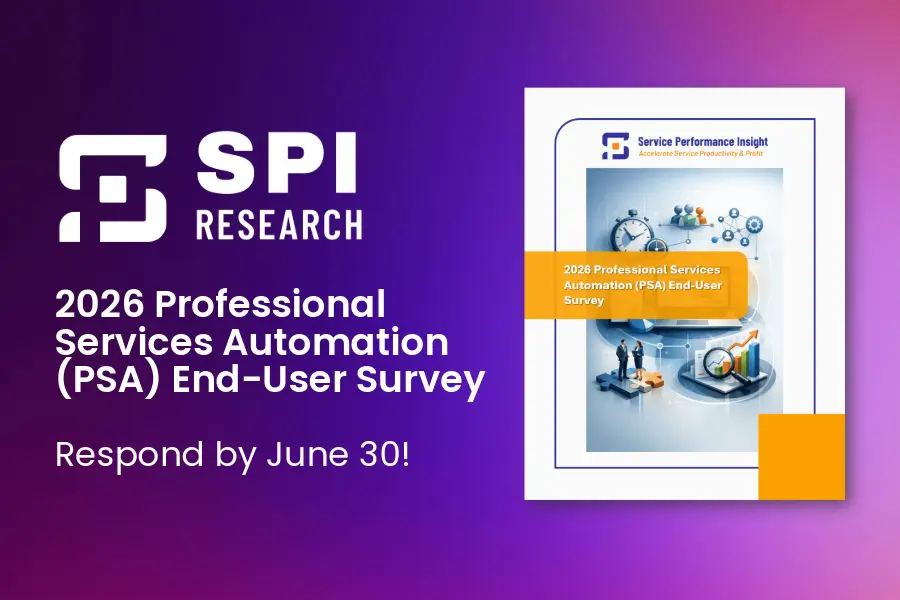
Now open: The 2026 Professional Services Automation (PSA) End-User Survey
SPI Research has launched its 2026 Professional Services Automation (PSA) End-User Survey to capture how modern services organizations leverage PSA platforms to optimize utilization, margins, and AI-driven automation. By participating in this 100% confidential study, you can help shape the definitive industry benchmark for operational performance across the project lifecycle. Complete the survey by June 30th and secure your complimentary copy of the final benchmark findings report when it publishes.
Industry Perspective
Accelerating with AI, Leading with Judgment: International Services Week 2026 Is Here
Professional services is moving through its most disruptive period since the internet reshaped knowledge work. Organizations navigating it well are building two capabilities simultaneously, not choosing between them. This post from Certinia CMO Mimi Spier frames the central tension heading into Services Week 2026: AI is already compressing timelines, absorbing intelligence-heavy tasks, and making the slow-movers obsolete, but speed alone carries real risk when client relationships and delivery quality still depend on human judgment. The piece outlines some of the week’s programming and a perspective on why this particular moment in professional services demands more than a technology investment.

Industry Perspective
Why Professional Services Organizations Keep Solving the Wrong AI Problem
In Harvard Business Review, Certinia COO Robert Cesafsky examines why AI investments keep falling short of expectations. His argument is that most organizations have misread the problem; treating AI as a single capability, when in reality services businesses run two distinct operations — services delivery and services management — that require fundamentally different AI approaches. The article explains the hidden cost that emerges when probabilistic AI gets applied to deterministic operational workflows, quietly erasing the efficiency gains it was supposed to create. And it lays out how the most forward-looking organizations are building toward an agentic operating model where both sides of the business eventually converge on a shared intelligence layer.
Industry Report
The Impact of AI on Professional Services
SPI Research’s 2025 Impact of AI on Professional Services study of 146 PS firms reveals a leadership test. Firms that build the conditions for AI to work will move ahead; those that do not will feel the gap widen over time. Adoption is on the rise, expectations have shifted and clients have begun to look for clear signs that their partners can work with modern tools. Yet performance impact is still uneven and the firms that are advancing have two defining advantages: stronger data discipline and workforce AI proficiency.
Industry Report
Diginomica enterprise data health research - the data is broken and everybody knows it
Enterprise data is widely broken, and leaders across the industry know it. The defining symptom is what a new diginomica report calls the "verification tax": practitioners spending 30–70% of their time manually reconciling and rechecking data before anyone will act on it, a habit that erodes organizational confidence and stalls AI initiatives before they reach production. The root cause is organizational rather than technical: fragmented ownership, cross-functional distrust, and in some cases deliberate silo maintenance, where controlling data means controlling the narrative come budget season.
Industry Report
Certinia 2025 Public Market Pulse Report
Certinia's inaugural 2025 Public Market Pulse report analyzed more than 4,000 quarterly earnings reports from 430+ of the world's top public services firms to understand how Customer Success (CS) and Net Revenue Retention (NRR) are shaping growth and investor confidence. The data reveals a widening performance gap: NRR mentions in earnings calls jumped 38% in 2023, with top-performing companies actively crediting CS for their results; while underperforming companies tend to reference it only as an aspirational recovery strategy. The study confirms that a proactive CS function is the clearest driver of renewals and expansion revenue in today's services market.
Industry Report
2026 Professional Services Maturity Benchmark
The SPI Research Professional Services Maturity Benchmark™ is designed to help Professional Service Organizations (PSOs) understand their relative performance compared to an expansive benchmark of peers. It provides visibility into critical business processes and key performance measurements so organizations can compare, diagnose and improve their own performance. It provides prescriptive advice so organizations can pinpoint current levels of maturity and visualize the steps required to advance to the next level.
Industry Report
2025 State of Service Report
Salesforce's seventh annual State of Service report draws on responses from 6,500 service professionals to track how AI is reshaping customer service. AI has jumped from the #10 to the #2 priority for service leaders in a single year — and 79% say investing in AI agents is now essential to meet business demands. Companies deploying AI agents are expecting a 20% reduction in service costs and case resolution times on average, but the report is clear that unified data remains the real differentiator: companies that consolidate their service channel data are 1.4x more likely to see successful AI outcomes.
Industry Report
PwC: AI Performance Study
PwC's AI Performance Study benchmarks 1,217 companies across 25 sectors on their AI-driven financial returns, and the concentration of value is striking: the top 20% of AI-fit companies capture 74% of AI-driven returns, with a 7.2x performance gap separating leaders from the rest of the field. The report identifies six foundational capabilities — strategy, investment, data and technology, workforce, governance, and innovation — as the drivers of that gap, and finds that companies strengthening these foundations see nearly double the payoff from new AI deployments. The core finding: leading companies treat AI as a growth and reinvention engine, not just a cost-reduction tool.

Industry Report
AI and the Future of Work
Deloitte's ongoing AI and the Future of Work research series examines the organizational and workforce implications of AI systems that can direct, delegate, and decide, not just assist. One of the series' standout data points: 36% of managers expect to be managing digital agents within five years, a shift that raises fundamental questions about structure, decision rights, and human roles. Deloitte frames the series as a long-term, multidisciplinary investigation into how work itself gets redesigned as AI moves from tool to collaborator.
Industry Report
Al Agents: Unlocking growth and innovation in the tech industry
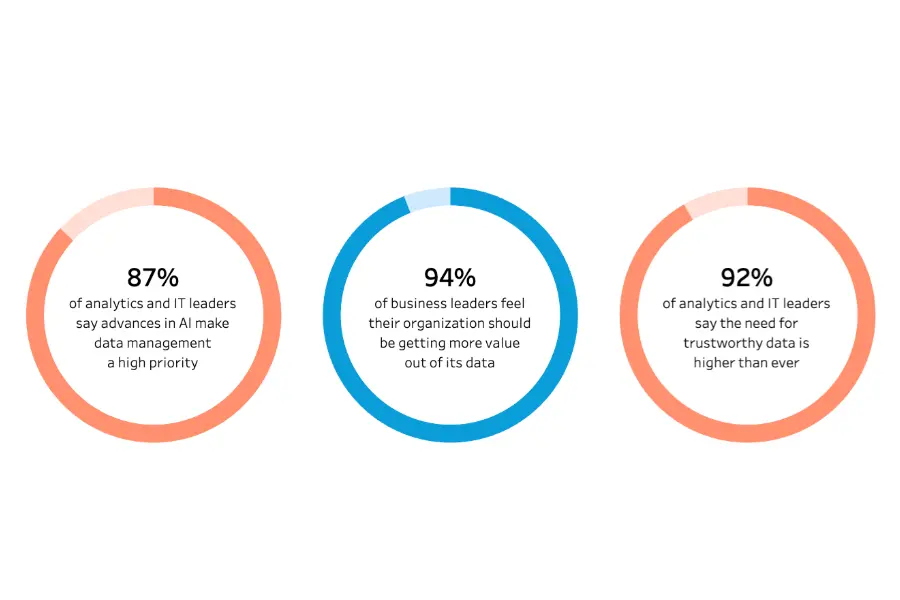
This ebook from Salesforce examines why agentic AI is the right answer to the tech industry's current pressure to grow efficiently, and not just quickly. Only 50% of tech companies have a distinct AI strategy, and 94% of leaders say they're not getting enough out of their data, two gaps the report identifies as the biggest blockers to meaningful AI deployment. Across sales, service, and marketing, the ebook shows how AI agents built on unified data can deflect up to 50% of service cases and free product teams to focus on what actually differentiates them.
Industry Report
2026 Digital Trends in Operations Survey
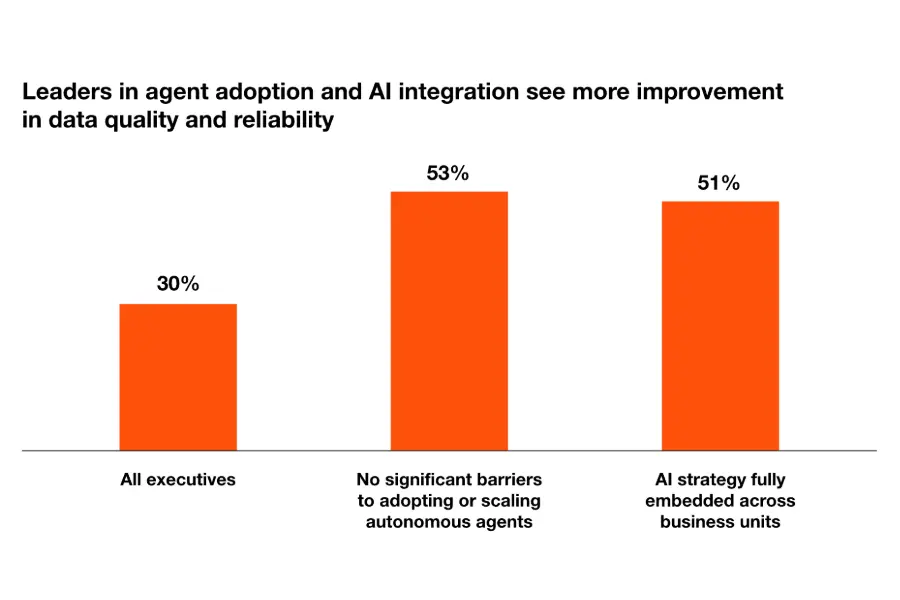
PwC's 2026 Digital Trends in Operations Survey of 767 US operations and supply chain leaders exposes a persistent confidence-execution gap: 85% say they're ahead of competitors in digital transformation, yet 89% say their technology investments haven't fully delivered expected results. Data quality is a compounding problem — 87% say poor data has hampered their ability to realize value from digital initiatives — and only 37% are comfortable assigning AI agents to run full end-to-end processes. The report argues that competitive advantage now belongs to organizations that integrate AI, data, and operating model transformation simultaneously, not sequentially.
Industry Report
State of AI in the Enterprise 2026
Deloitte's annual State of AI in the Enterprise report, based on a survey of 3,235 senior leaders across 24 countries, maps where enterprise AI stands heading into 2026. Worker access to AI rose 50% in a single year, and the number of companies with at least 40% of projects in production is expected to double within six months — yet only 34% of organizations are truly reimagining how their business works. The governance gap is especially sharp for autonomous AI: only 1 in 5 companies has a mature model for overseeing AI agents, even as agentic adoption is poised to surge.
Industry Report
2026 AI in Professional Services Report
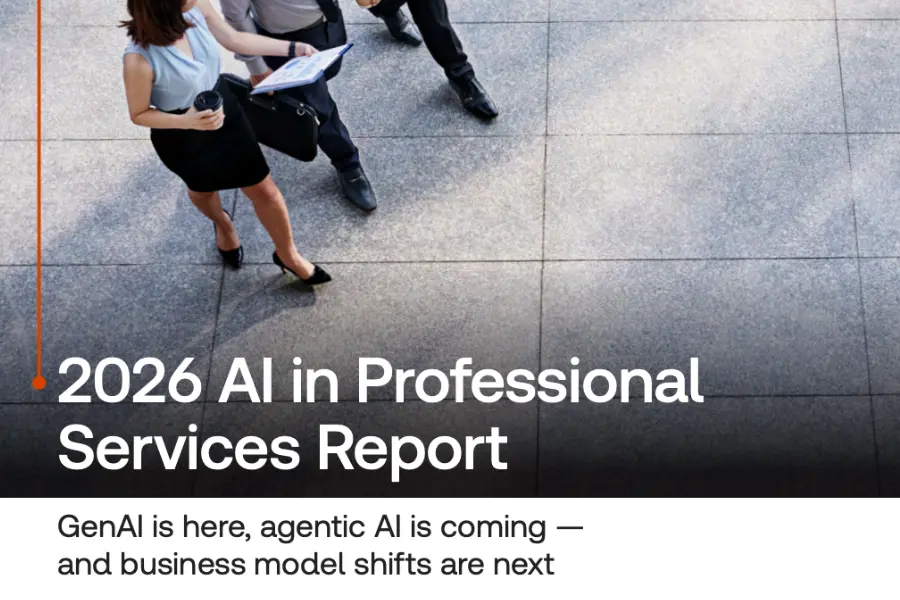
This report from the Thomson Reuters Institute examines how AI is reshaping the legal, tax, accounting, risk, fraud, and government sectors. Drawing on perspectives from more than 1,500 professionals, this report highlights that the era of early AI adoption has passed. Today marks the strategic phase of AI, in which organizations redefine workflows, reshape value, and build AI directly into the foundation of their business strategy. Discover a clear view of where generative AI (GenAI) and agentic AI are gaining traction, how expectations and business models are shifting, and how leaders need to prepare as AI becomes an essential pillar of professional work.
Industry Report
2025 Responsible AI Survey
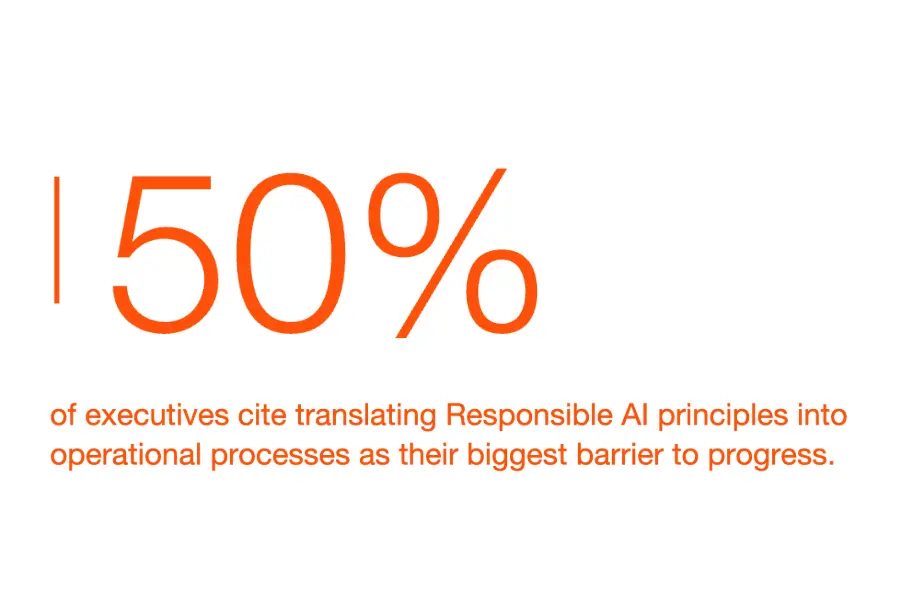
PwC's 2025 Responsible AI Survey — based on 310 US business leaders — makes a financial case for governance: nearly 60% of executives say Responsible AI practices improve ROI and organizational efficiency, and 55% report gains in both customer experience and innovation as a result. Despite that, only about a third of organizations have fully embedded AI governance into core operations, and operationalizing Responsible AI at scale remains the top reported challenge. The report also flags a governance urgency tied to the rise of AI agents, which require ongoing oversight rather than the static controls built for earlier AI systems.

Industry Report
MuleSoft Connectivity Benchmark Report
MuleSoft's 10th annual Connectivity Benchmark Report, based on a survey of 1,050 enterprise IT leaders, reveals the structural gap blocking effective AI adoption: 95% of respondents say they struggle to integrate data across systems, and on average only 29% of applications within an organization are connected. The report identifies this fragmentation as the central obstacle to building the kind of reliable, data-grounded AI agents that enterprises are racing to deploy — and finds that IT staffing costs surged 61% year-over-year as teams scramble to keep up with demand.
Industry Report
The State of Data and Analytics Report
Based on survey data from more than 10,000 analytics, IT, and business leaders, Salesforce's State of Data and Analytics report examines why AI ambitions so often fall short in practice. Nearly 9 in 10 organizations admit their AI systems have produced inaccurate or misleading outputs — a problem the report traces back to fragmented, poorly governed data. Leaders are responding by prioritizing data governance as the foundational step before any meaningful AI deployment can happen.
Industry Report
PwC: AI Agent Survey
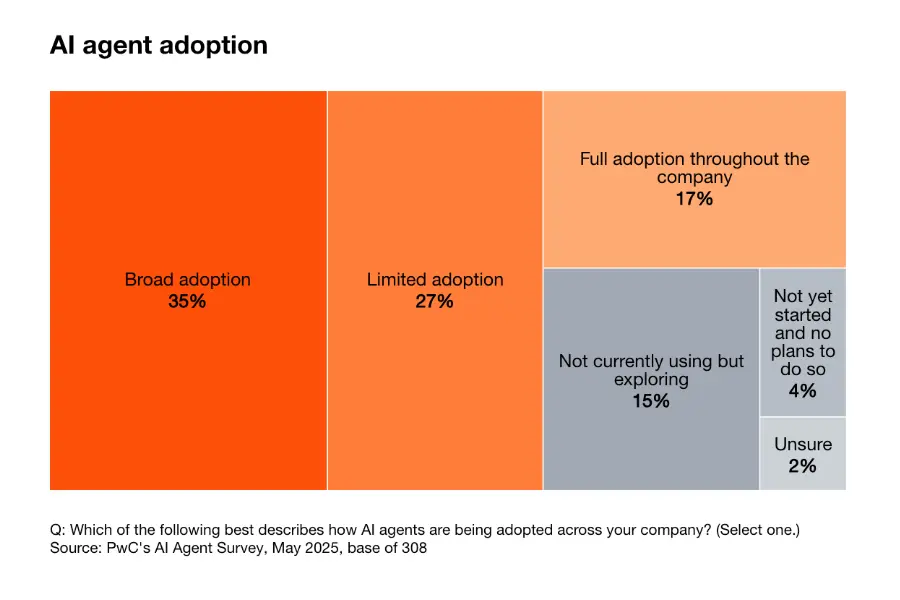
According to a May 2025 survey of US executives, companies are rapidly increasing budgets for AI agents and are already seeing measurable value, particularly in productivity. However, the report argues that the biggest barrier to deeper transformation isn't the technology itself, but rather human-centric factors like organizational mindset, change readiness, and a lack of trust in high-stakes use cases. Most businesses are still using agents for isolated tasks instead of orchestrating them across workflows, which is where the greatest competitive advantage lies.

Industry Report
Deloitte: Agentic Enterprise 2028
Deloitte's Agentic Enterprise 2028 report provides a strategic blueprint for how businesses should prepare for a world where AI operates far more independently than it does today. The report maps six levels of agentic AI maturity — from basic task automation through to self-improving autonomous systems — and traces how the human role changes at each stage, shifting from operator to orchestrator to strategist. Deloitte argues that organizations that begin the transition now will secure compounding advantages in cost, speed, and talent deployment by 2028.
Industry Report
Tech Trends 2026: AI Comes of Age
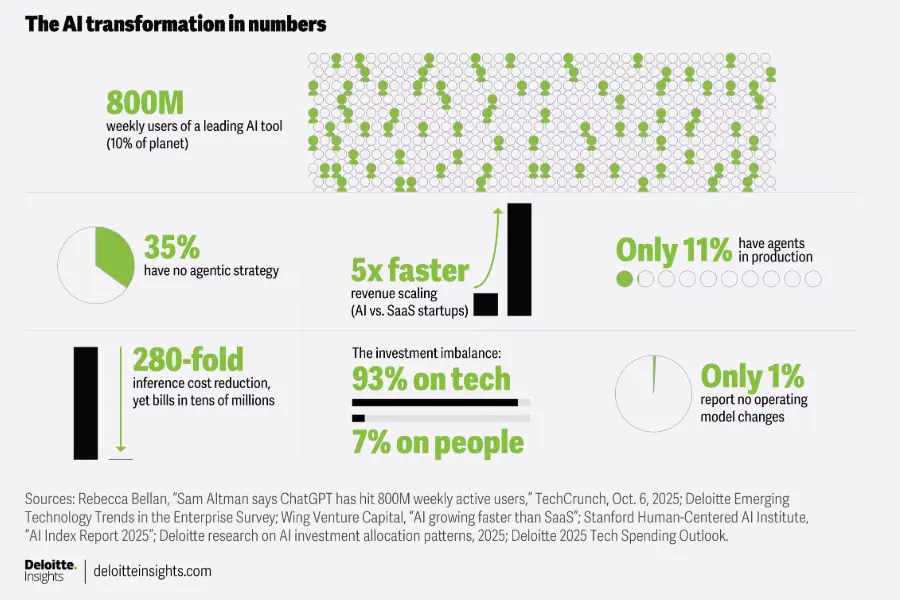
Deloitte's 17th annual Tech Trends report examines five interconnected forces reshaping enterprise technology through 2026, with agentic AI and the rise of a hybrid human-and-silicon workforce at the center. The data is sobering: only 11% of organizations have AI agents in production despite 38% piloting them, and Gartner predicts 40% of agentic AI projects will fail by 2027 — not due to technical limits, but because organizations are automating broken processes rather than redesigning operations. The report's recurring theme: organizations still in pilot mode are falling behind those with the discipline to rebuild from the ground up.

Industry Report
Top Generative AI Statistics for 2025
Compiled from Salesforce's ongoing Generative AI Snapshot Research Series — spanning over 4,000 full-time workers across industries — this data roundup tracks how generative AI is spreading (and stalling) across the workforce. The headline figure for service teams: 9 out of 10 service professionals already using generative AI say it helps them serve customers faster. Yet adoption in service remains the lowest of any function surveyed, with skills gaps and trust concerns slowing the majority from getting started.

Industry Perspective
AI Revolution: Shaping the Future of the Workforce
Written by Lori Steele, President of Salesforce Global Professional Services and Forward Deployed Engineering, this piece lays out a practical playbook for building an AI-ready professional services workforce. Steele organizes the framework around four pillars — culture of innovation, customer value, trust, and a continuous improvement flywheel — and backs it with results: 95% of customers who partner with Salesforce Professional Services report faster innovation, and one Fortune 100 engagement cut time-to-go-live by 50%. The piece makes a direct case that AI readiness in PS requires structural commitment, not experimentation at the margins.

Industry Perspective
Scribe Or Operator? The AI Architecture Question Most Professional Services Firms Are Getting Wrong
Research shows that nearly 90% of AI projects in professional services are stuck at the early stages; useful for meeting notes and document generation, but nowhere near the operational impact firms are promising their boards. In Forbes, Certinia CPTO Raju Malhotra explains why. Most firms are deploying what he calls a "scribe" — a tool that handles language well but has no awareness of the financial, contractual and resourcing structures that actually run a services business. An "operator" is different: an agentic system that reasons within hard business rules, executes actions across platforms and handles downstream consequences without a human handoff between systems. He presents a practical framework for pressure-testing whatever AI you have deployed today across three dimensions: whether it understands your business or just predicts text, how it separates fluency from accuracy, and what it can actually execute across systems simultaneously.

Industry Perspective
How the AI Revolution is Rewriting Professional Services
The economics of professional services have long run on a straightforward premise: expertise multiplied by time. AI is straining that model in ways that are already showing up in the numbers, with the top 20% of AI-mature firms posting billable utilization above 74%, EBITDA margins in the mid-20s, and revenue per consultant more than 50% higher than peers. In Inc., Certinia CEO DJ Paoni argues that the real strategic question for professional services leaders is how to deploy AI across intelligence-heavy work (drafting, research, analysis, structured data) while deliberately positioning human expertise around judgment: knowing which client risks matter, when to push back, and how to earn trust.

Industry Perspective
The hidden tax of “Franken-stacks” that sabotages AI strategies
Enterprise AI agents fail not because of flawed AI models, but because they're layered on top of fragmented "Franken-stacks" — disconnected point solutions that deny agents the full business context they need to reason accurately. As Certinia’s Raju Malhotra writes in VentureBeat, the fix is simple: a platform-native architecture built on a unified data model, where all business data lives in one place, giving AI agents a complete, real-time view of operations without translation layers or sync delays.

Industry Perspective
Diagnosing the AI Readiness Gap in Professional Services
Professional services firms are struggling to convert AI pilots into measurable business results, with the core problem being that early initiatives were designed for experimentation rather than production-grade ROI — and firms that focus on tooling while underinvesting in data quality and process standardization rarely bridge that gap. In Enterprise Times, Steve Brooks writes how success hinges on treating AI as a strategic lever for growth and efficiency, with hybrid human-and-agent delivery teams operating across connected, well-structured workflows.
Industry Perspective
How These Companies Are Upskilling Employees To Leverage AI
Comparably highlights how five companies are approaching AI workforce readiness, with the shared takeaway that the most effective strategies put people first rather than focusing purely on tool adoption. Each company uses a mix of foundational literacy programs, role-specific training, governance frameworks, and hands-on experimentation to build cultures of AI fluency across their organizations.