

Analyzing the 2026 SPI Research Professional Services Maturity Benchmark Report

Summary
This blog breaks down five critical trends from the 2026 SPI PS Maturity Benchmark Report, exploring how professional services firms can navigate slower market growth, falling utilization, and the rising demand for AI-led solutions.
Now that we are hitting the midpoint of 2026, it's clear the professional services market isn't broken, but the old playbook definitely is. We’ve successfully transitioned away from the reactive survival mode of recent years, but we’ve landed in a challenging climate where operational precision and execution discipline are absolutely everything.
Per the 2026 SPI Professional Services Maturity Benchmark Report, the market is improving, but growth is still slower than many leaders want. AI is becoming part of delivery, but not every firm is ready to turn it into measurable value. Attrition has eased, but the skills required to compete are changing fast. Meanwhile, profitability is holding steady, but high-maturity firms are widening the gap between themselves and the rest of the market.
When the report came out in Spring, it gave us a clear view of the hard data driving these shifts. Based on responses from 509 professional services teams, the benchmark brings to light five critical factors you need to address to maintain competitiveness, drive growth, and adapt to changing market dynamics as we head into the back half of the year.
Growth is back, but it is not easy growth
Professional services revenue growth reached 5.2% in 2025, up from 4.6% the year prior. That’s a positive step, but it still sits well below the historical 10% growth rate SPI usually tracks for the industry.
This gap matters because you can no longer rely on a rising market tide to lift your performance. Clients are heavily rewriting their buying criteria. While they still need help navigating transformation, risk, and operational change, they are making decisions with extreme caution. They want stronger business cases, guaranteed outcomes, and the faster time-to-value that only AI-led solutions can deliver.
For services leaders, this puts intense pressure on the front end of the business. Securing sustainable growth requires total operational visibility long before a deal is signed. You need to know exactly which opportunities to pursue, whether you have the real-time capacity and skills to deliver them, and if the work will ultimately be profitable. A strong pipeline is great, but a pipeline you can't staff effectively is just a future margin problem.
What leaders should ask: Do we have the granular visibility into our pipeline, capacity, and skills needed to confidently identify and deliver on the AI-led growth opportunities that will drive long-term profitability?
Utilization is becoming harder to protect
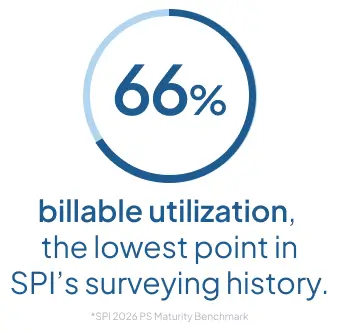
Billable utilization fell to 66.4% in 2025, marking the lowest point in SPI's surveying history. This is easily one of the most important numbers in the entire report.
Utilization sits close to the center of a services business. When it drops, the impact ripples through revenue, margins, staffing plans, and client delivery. The challenge is that utilization problems almost always start before a project begins, driven by small disconnects across the business. Sales sees demand building before delivery can plan for it, resource teams know who is available but not necessarily who is best suited for the work, and project scopes shift faster than your staffing plans can adjust.
When those gaps add up, margin pressure becomes visible only after the damage has already started. This is why utilization cannot be treated as a monthly reporting metric alone; it has to be managed earlier, while there is still time to make better decisions.
What leaders should ask: Are we building the operational visibility needed to balance utilization as our delivery models pivot from manual hours to AI-led efficiencies?
AI is showing up in real project work
The report found that 27.1% of projects used generative AI in 2025, which is a 40% increase from the previous year. That officially moves AI out of the "future of services" conversation and right into your current operating reality.
But the more useful question is not whether firms are using AI—many are. The better question is whether firms are just using AI as an internal administrative assistant, or if they are architecting the actual solutions around AI to give clients the leading-edge delivery they are demanding
AI can support faster decisions, better forecasting, smarter staffing, and more efficient delivery. But it needs the right foundation. If data is scattered, skills are not visible, project information is incomplete, or governance is unclear, AI will struggle to deliver consistent value. AI does not fix a disconnected operating model; it exposes it.
What leaders should ask: Is our broader organizational infrastructure ready to leverage AI for end-to-end performance improvement, or are we simply deploying isolated, disconnected tools?
Talent pressure is shifting from retention to readiness
Employee attrition stabilized at 11.4%. After several years of workforce volatility, that is encouraging news. But lower attrition does not mean the talent challenge has been solved—the next phase is all about readiness.
Because clients are demanding solutions with AI as a lead, consultants must quickly shift from traditional executors to AI-augmented strategists who know how to co-deliver value alongside automation. They need stronger data literacy, a better understanding of AI-enabled tools, and the judgment to use automation without losing expert-led quality.
This completely changes how leaders must think about workforce planning. It is no longer enough to just know who is available. You need to know what people are skilled in, where they can grow, which capabilities are becoming more important, and how upcoming demand should shape your hiring and upskilling plans. Delivery strategy and talent strategy are now one and the same.
What leaders should ask: Have we thoroughly mapped our team's current skills and capacity against future demand to ensure our workforce is prepared for evolving delivery models?
Profitability is stable, but average performance is not the goal
Average EBITDA stabilized at 9.9%. That provides some reassurance, but the benchmark’s deeper story is about the gap between high-maturity firms and everyone else.
High-performing PSOs are winning because they have aligned their operations to support an AI-first world. You cannot successfully lead with AI on the front end if your back-end data, finance, and resource management are completely disconnected.
That alignment matters because professional services performance is deeply connected.
- Weak estimates can become a delivery issue.
- Staffing delay can become a revenue issue.
- Project overrun can become a client issue.
- Billing delay can become a cash flow issue.
- Poor forecasts can become a hiring issue.
High-maturity firms are better at seeing these connections early. They have stronger planning discipline, better use of business applications, clearer financial visibility, and more consistent execution. That gives leaders more room to act before small problems become expensive ones.
What leaders should ask: Where are fragmented, disconnected decisions creating blind spots across our business functions, and how can we better align our operations end-to-end?
The Big Picture: Connecting the Dots
The lesson for 2026 and beyond is clear: the next phase of performance will depend entirely on how well your team connects its decisions. A pipeline cannot sit apart from staffing, staffing cannot sit apart from skills, and project delivery cannot sit apart from financial performance.
To see exactly where your team stands, download the full 2026 SPI Professional Services Maturity Benchmark Report to compare your metrics against the latest market data and see what high-performing teams are doing differently.
Explore Related Content
Recent Articles





Run your services business with clarity, speed, and confidence